
I showed that the lack of plasticity in birth timing in roe deer prevents the females that give birth relatively late in the birth season to adapt to climate change.
Climate change has led to an advance in spring phenology. Therefore, the period when the vegetation is easily digestible and provides the highest energetic food for roe deer has advanced over years. In contrast, the period of fawn births has not changed. I found that the decrease in fawn survival was due to a higher mortality among fawns born relatively late during the birth season. Indeed, these late fawns suffered from an increasingly late birth date compared to the peak of abundance of quality resources. This decrease in fawn survival and development has resulted in a 6% reduction in the population growth rate over 25 years.
Context
The roe deer is a charismatic species living in the European countryside. This small ungulate is a solitary species living in the woods that feeds on young buds and growing stems in clearings. A population with these original characteristics has been studied since 1975 by the ONCFS (now the French Biodiversity Agency) and the CNRS. I analysed the performance of this population and observed a slowdown in its recruitment (reproductive success). I studied whether climate change was responsible for the decrease in recruitment and what the impacts at the population level were.
Challenge
What are the consequences of climate change on population dynamics?
Approach & Results
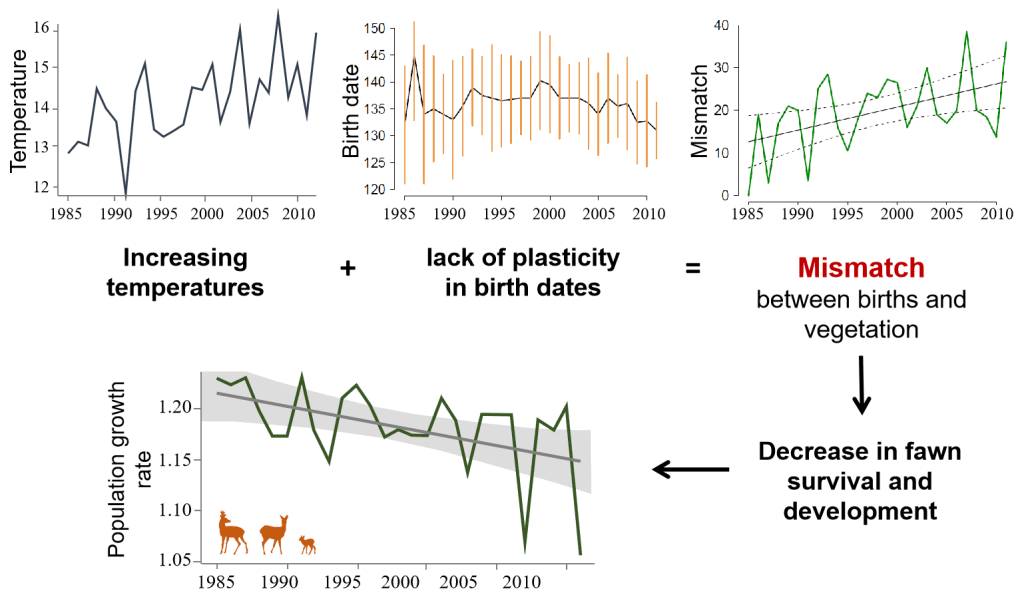
I started by listing all the environmental, climatic and human factors that could have influenced this population of roe deer. I obtained past climatic data from French climatic stations. I studied the increase in temperatures and the variations in precipitation. I also analyzed the average changes in survival, reproductive success and body mass in this population. I showed that fawn survival and mean individual body mass at one year old decreased over time. However, these results did not prove that the increase in temperature caused these decreases yet.
Thanks to bibliographical research and discussions with my collaborators, I knew that the roe deer feed primarily on buds during the birthing period. Indeed, as with all mammals, parturition and lactation are very demanding times for females who need resources of high quality. To meet these demands, does feed on young buds and stems with very little lignification for their ease of digestion. However, the increase in temperatures likely led to an earlier budding date than normal. I contacted the National Forestry Agency to receive records of vegetation bud break in the region over the past 30 years. It indeed showed that the increase in temperatures had led to a significant advance in the budding dates of hornbeam and brambles, the deer favored food.

Using survival models, I studied the first year of life and showed that annual fawn survival had decreased. Variation in annual mean fawn survival correlated with variation in annual date of vegetation bud break. I then thought about using the within year variability in fawn survival to demonstrate the link between the survival of each fawn and the gap between its own date of birth and the annual date of vegetation bud break. By combining within- and between-years variability in survival and growth, I was therefore able to demonstrate the link between climate change and the decrease in fawn survival and development. Finally, I used all these results to build a global model of population dynamics (integral projection model) to quantify direct and indirect consequences of climate change on population dynamics through decreases in body mass, survival, and reproductive success.
Collaborators
- Jean-Michel Gaillard, Christophe Bonenfant: Laboratory of Biometry and Evolutionary Biology, UMR 5558, University Claude Bernard Lyon 1, France
- Tim Coulson: Oxford University, United-Kingdom
- J. Mark Hewison: INRAE, UR035 CEFS, Castanet-Tolosan France
- Daniel Delorme, Claude Warnant: Centre National for Applied Studies and Research on Cervids & Wild boar, French Biodiversity Agency, Paris, France






Links to associated articles
- Mismatch Between Birth Date and Vegetation Phenology Slows the Demography of Roe Deer. PLoS Biology. Plard et al.
- The influence of birth date via body mass on individual fitness in a long-lived mammal. Ecology. Plard et al.
- Will Roe Deer Persist in a Warmer World? PLoS Biology. J. Chase
- Will roe deer persist? Climate change spells disaster for species unable to keep up. Sciences daily
 Floriane Plard