I showed how the influence of variation in selective pressures acting on body size on population dynamics can be predicted, even from limited data.
The increase in temperatures linked to global change is leading to an alteration of selective pressures acting on body size of ectotherms such as Amphibians. Using a Bayesian approach, I showed that a 1% decrease in the selecting pressure linking body size to survival would cause a 3 to 4% decrease in the population growth rate of this already declining population. Combining survival, reproduction and growth data collected using a three years capture-mark-recapture protocol, I showed how indirect consequences of climate change can be studied from limited data and incomplete recaptures.
Context
In ectotherms, the increase in temperature is expected to directly influence metabolic reactions that determine the maintenance and development of organisms. As a consequence, the selective pressures acting on individual body size are expected to be altered as body size will not be adapted anymore to the quantity of energy produced by metabolism. These modifications should impact individual survival and reproduction, and population dynamics and viability as a consequence. Models of population dynamics that account for the influence of body size on survival and reproduction are thus needed, in particular among under-studied but threatened groups such as amphibians.
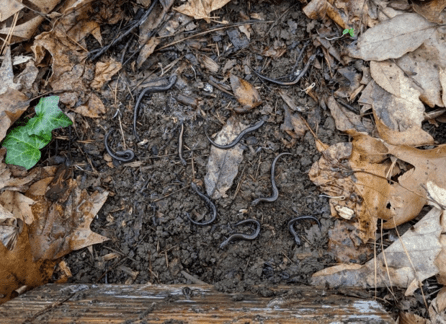
The red-back salamander Plethodon cinereus is an amphibian living in Canada and in the North of the USA. This species is declining in the South of its range. Researchers from the University of Richmond, Virginia have monitored a population of red-back salamanders during three years. From the data collected, I built a model of populations dynamics to assess the indirect impact of climate change on population dynamics through the alteration in selecting pressures acting on body size.
Challenge
Predict the consequences of physiological modifications created by climate change on population dynamics from limited data.
Methodological Approach
Using a Bayesian approach, I developed an integral projection model capable of predicting the potential impact of climate change on the dynamics of a population of red-back salamanders. Survival, reproductive, and growth parameters have been estimated from the three years data of capture-mark-recapture. Because these data were not sufficient to estimate all needed parameters, we used data from the literature on the red-back salamander to complement the model. The latter have been used to estimate breeding probability, hatching probability, recruitment probability and juvenile size.
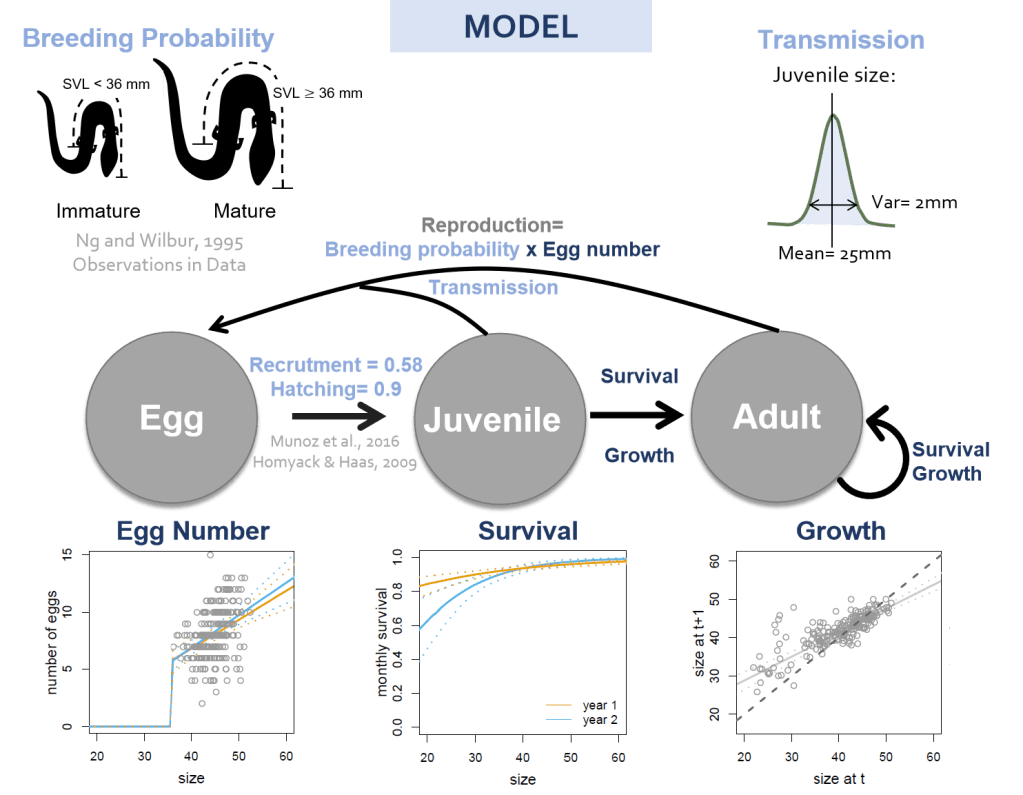
I made sure to demonstrate that the model assumptions did not influence our results. To do this, I compared the predicted and observed population distributions of body size. I also performed sensibility analyses to show that our results were not sensible to the parameters estimated from the literature data. Making the most of the Bayesian approach, I was able to provide predictions including all the incertitude generated from the data collected.
To estimate the consequences of climate change at both individual and population scales, I used the model to simulate an alteration of each selective pressure acting on body size: through viability selection using the survival function and through the selective pressure acting on growth. The growth function was modeled using a von Bertalanffy model including two main parameters: individual growth rate and asymptotic body size.
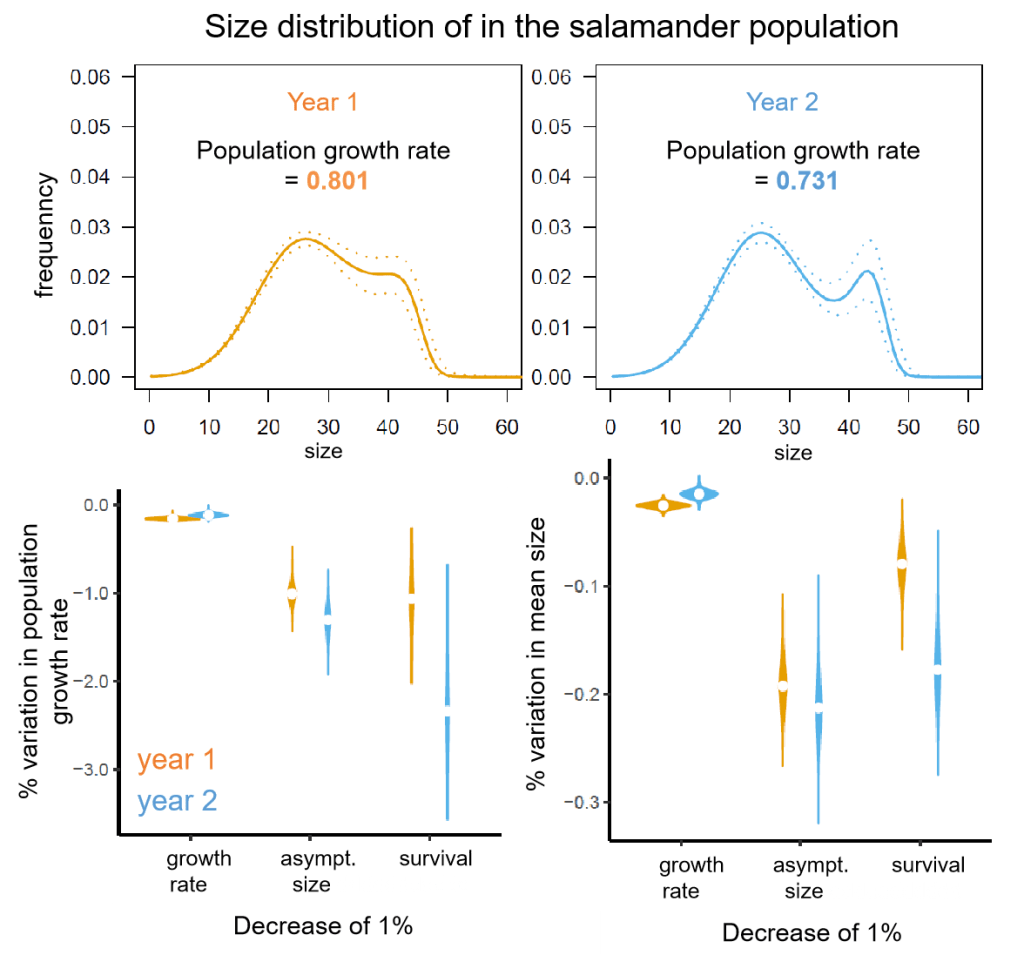
I showed that a simple 1% decrease in the selecting pressure linking body size to survival would cause a 3 to 4% decrease in the population growth rate of this already declining population (λ = 0.8). This study shows that some models of population dynamics can be used to study the impact of climate change even on populations monitored over a short time. Information collected in the literature allows making robust assumptions about unknown parts of life cycles and weakly variable demographic rates.
Project leader and Collaborators
- Raisa Hernández-Pacheco : Department of Biological Sciences, California State University-Long Beach, Long Beach, CA, USA
- Ulrich Steiner: Evolutionary Biology, Institut für Biologie, Freie Universität Berlin, Berlin, Germany
- Kristine L. Grayson: Department of Biology, University of Richmond, Richmond, VA, USA



 Floriane Plard