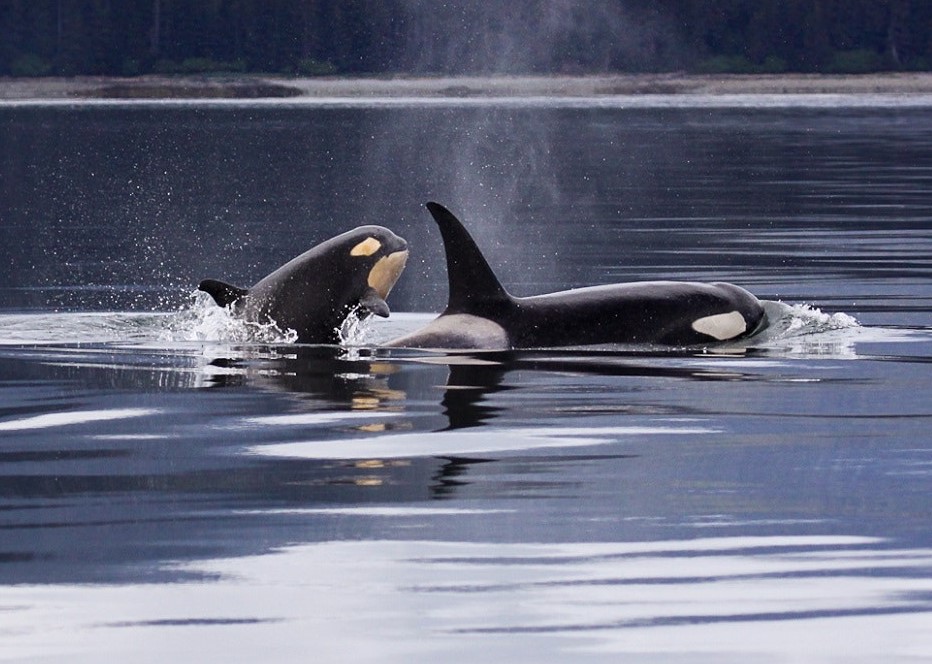
This study documents the increased number of killer whales depredating on fisheries between 2003 and 2018. Individuals belonged to two populations of two sympatric forms of subantarctic killer whales.
Combining photo-identifications taken from the coast and from fishing vessels, this study examined how the behavior of “depredation” on fisheries has spread within two populations of top predators. A Jolly Seber multi-event model including data augmentation was used to estimate the annual probability of starting depredation and to analyze temporal trends in the annual number of depredating killer whales. It took 18 years for the depredation behavior to spread to the entire regular population.
Context
In marine environments, fishing is the main activity generating anthropogenic resources for opportunistic species. A foraging behavior, called “depredation” has recently emerged as a major human-wildlife conflict. Depredation is defined as orcas feeding on fish caught on fishing gear. It is occurring on a global scale, involving a wide range of fisheries and top predator species as well as generating substantial socio-economic and ecological impacts.
A team from the French National Research Institute for Sustainable Development in collaboration with Deakin University in Australie is studying the evolution of interactions between fishing boats and populations of killer whales in French subantarctic waters. A Master project aimed to understand how this new behavior of “depredation” spread among individuals. This team requested my support to choose the statistical approach and to supervise the master student in building a robust model to estimate the evolution of the number of depredating killer whales. This study was carried out because of the monitoring of Crozet killer whales by photo-identification provided by the Center for Biological Study of Chizé, in collaboration with the MNHN of Paris and the french austral and antarctic lands (Fisheries and Environment Service)
Challenge
Estimate the annual number of individuals depredating on fisheries and its evolution over time in two populations belonging to two different forms of killer whales: regular killer whales and type D killer whales from incomplete photo-identification data.
Methodological Approach
Available data for this study combined opportunistic photo-identifications taken from the coast of the Crozet islands and photo-identification taken from fishing vessels operating off the islands by a trained observer from 2003 to 2018. In order to estimate the annual number of depredating killer whales in regular and type-D populations, I chose to use a multi-event Jolly Seber model using data augmentation technique. I helped the student to build two independent models, one for each population.
We analyzed the robustness of the model to the violation of three hypotheses: (i) Because killer whales live in socially structured groups, the recapture (photo taken) probabilities of the different individuals were not independent, (ii) Because the probability to recognize an individual differs according to individual distinctiveness value, recapture probabilities are not equal among individuals (iii) Because many individuals could not be sexed from the photo, sex difference in survival probability was not accounted for in our model. To assess the robustness of our model to these violated assumptions, we simulated data that we could virtually obtain from true killer whale populations with known demographic parameters. We checked that our model was able to estimate these parameters back. In other words, we confirmed the absence of significant bias in the parameters estimated from our model.
In addition to the annual number of depredating killer whales, our model made it possible to estimate four groups of parameters for regular killer whales (1.2.3.4) and three for Type-D killer whales (1.2.3):
- The annual recapture probability, depending on the photo-identification platform (coastal or fishing vessels)
- The survival probability, depending on age class and behavior (depredating vs non-depredating)
- The annual probability of starting depredation
- An entry probability into the population, estimated for regular killer whales only as the probability of individuals joining the population as non-depredating individuals through recruitment or immigration.
To find out whether the number of depredating killer whales had reached a plateau or continued to increase, we tested for the occurence of linear and non-linear temporal trends.

In both populations, the number of depredating individuals increased during the study period from 34 to 94 regular killer whales and from 19 to 43 Type-D killer whales. Among regular killer whales, the number of depredating individuals has stabilized in 2014. Thus, it took 18 years for this behavior to spread to the entire population. Our results showed how changes in prey availability introduced by human activities lead to rapid, but incremental, innovations in killer whales, probably altering the ecological role of this prominent ecosystem predator.
Project leader and Collaborators
- Paul Tixier, MARBEC University of Montpellier-IRD, Sète, France
- Morgane Amelot, previously in Master at School of Life and Environmental Sciences, Deakin University, Australia
- Christophe Guinet, Centre for Biological Studies of Chizé, La Rochelle University, Villiers-en-Bois, France
- John P. Y. Arnould, School of Life and Environmental Sciences, Deakin University, Australia
- Nicolas Gasco, Laboratory of Biology of Aquatic Organisms et Ecosystems, MNHN, Paris, France





 Floriane Plard