
I combine fundamental and applied research to provide a better understanding of the influences of environmental and human changes on wild populations.



Applied Research
Population dynamics, Management & Conservation
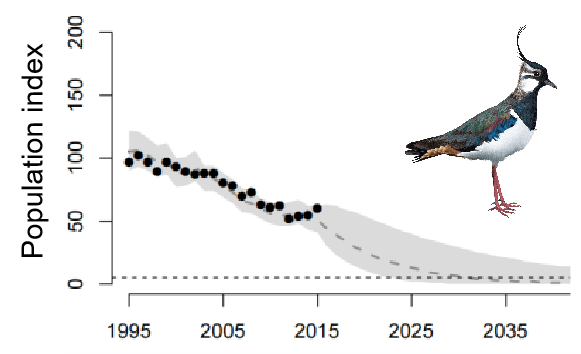
Population dynamics describe how the size of a population changes over time. I study the drivers of wild population dynamics with the aim of enabling managers to take more effective conservation and management actions. In particular, I study how climate change or the degradation of natural habitats influence the resources of wild populations and how this lack of resources impacts the development, survival, reproduction and spatial movements of individuals. Understanding which population demographic processes are affected is needed for effective management and conservation actions.
A decrease in resources can have different consequences for different species. Some species, such as large mammals, will produce lighter young of lower quality. In these species, it is therefore necessary to quantify the long-term influence of the decrease in individual quality on population dynamics. Other species will produce fewer young. In social species such as the marmot or the killer whale, this decrease will lead to smaller families who will have restricted capacities to hunt or defend themselves. To predict global consequences on wild populations, I study both the short and long term, and both direct and indirect impacts of environmental change on demographic processes acting at the individual, group and population scales.
Modeling and Robustness Analyses
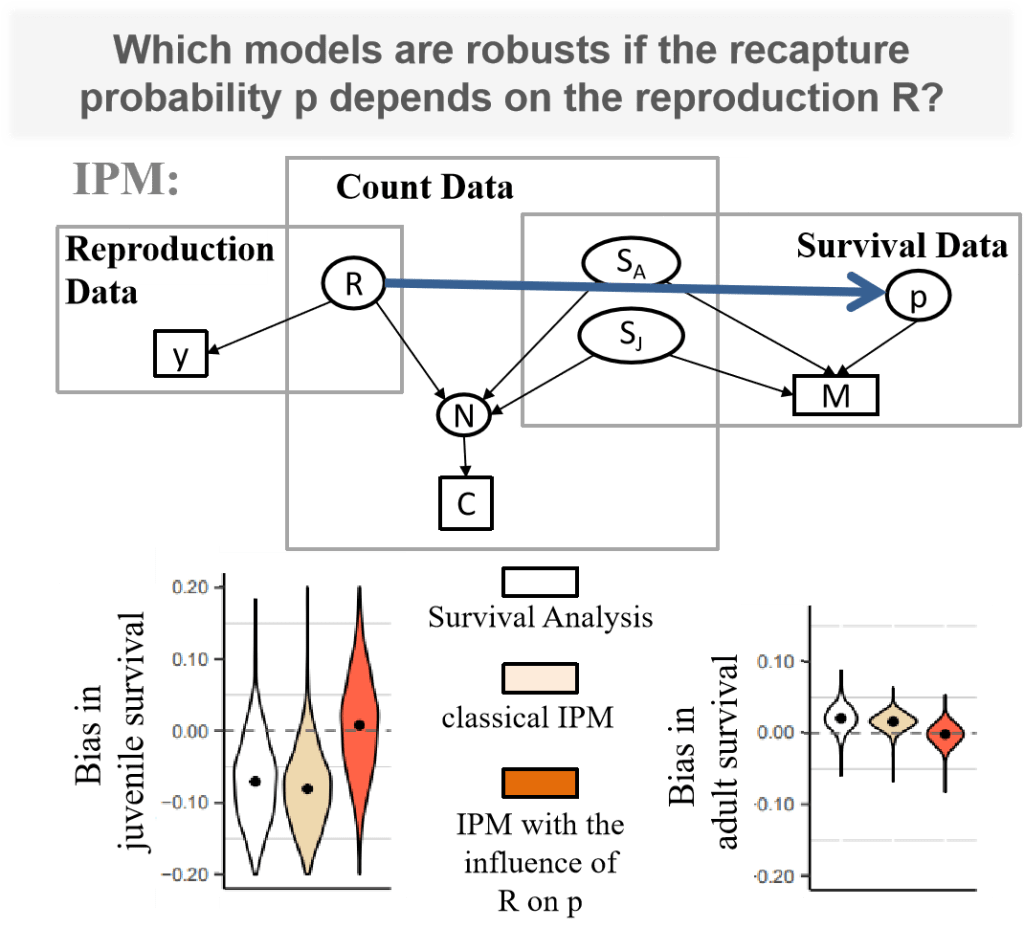
The difficulties in studying management and conservation issues lie in the typical short duration of field studies, the often too small population size already reached by a declining population and our limited knowledge of wild populations. Sometimes we need to make the most of opportunistic data, which are the only data available. Conversely, models of population dynamics have been developed using data collected rigorously, on a sufficient number of individuals over several decades. I therefore study the robustness of population dynamic models to understand what their limits are, in which contexts, under which assumptions and with how much data we can use them. I assess how complex a model should be to give robust results. I also combine different types of data to get robust and useful results depending on the question.
Fundamental Research
Theory of life-history strategies

Current global change imposes a rapid adaptation of natural populations which hinder us in comprehending their real consequences on biodiversity. Population resilience depends on their capacity to show plastic or evolutionary responses to these global changes. Predicting evolutionary and plastic responses of wild populations would allow us to discern the real consequences of current climate change on biodiversity.
Intuitively, we can easily guess that a population of butterflies and a population of whales will not have the same tools to adapt to varying environmental conditions. A butterfly has more evolutionary adaptive capacities. It will use its rapid reproduction and large number of eggs to produce different young. The ones that will be adapted to the environmental conditions will survive. A whale has above all plastic adaptive capacities. It will patiently wait for a year when environmental conditions are favorable to produce a young. To promote the survival of this particular young, it will allocate a great deal of energy in maternal care using the reserves gathered until then.
Population dynamics are described by demographic processes such as survival, development and reproduction. Under varying environmental conditions, it is necessary to predict which of these processes have the potential to vary over time to predict how the population will respond to global change. Demographic processes are influenced by the life history strategy (in particular on the slow-fast continuum) that characterizes each species. I study the variability of these life history strategies to provide a better understanding of the evolutionary and plastic capacities of wild populations. This allows me to predict with higher accuracy how each population will be affected by an environmental change.
Individual Heterogeneity
Population modeling has for long described a population as a given entity, excluding individual heterogeneity (in size, mass, behavior, genetics…). Population viability analyses which study the potential extinction of wild populations include mean and constant demographic rates for instance, and are often criticised for their lack of realism. Indeed, wild populations are composed of both high quality individuals that combine high survival and high reproductive success, and low quality individuals that combine low survival and low reproductive success. In addition to heterogeneous contributions to the population in terms of survival and reproduction, we now know that individuals also have heterogeneous plastical responses to environmental change.
I study how the composition of a population, in terms of individuals of different quality with heterogeneous plastic and evolutionary responses, influences population dynamics in variable environments. To be able to predict individual quality, I also analyze the factors that shape individual quality.

Development of statistical models
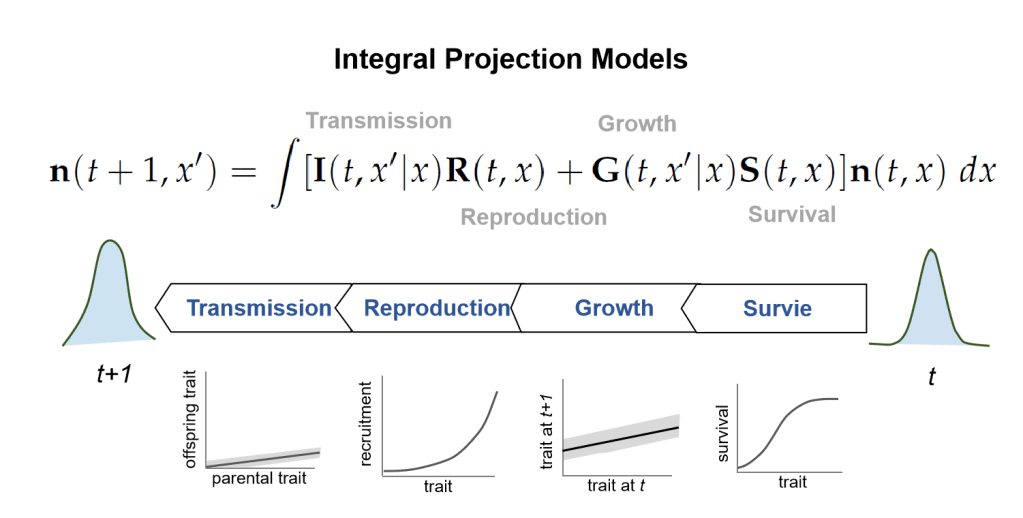


To predict the future of wild populations, we need to develop a conceptual framework combining population dynamics, evolution and plasticity in eco-evolutionary models being able to predict adaptive capacities of populations in an increasingly variable environment. These models must also account for the dynamics of individual heterogeneity within each population.
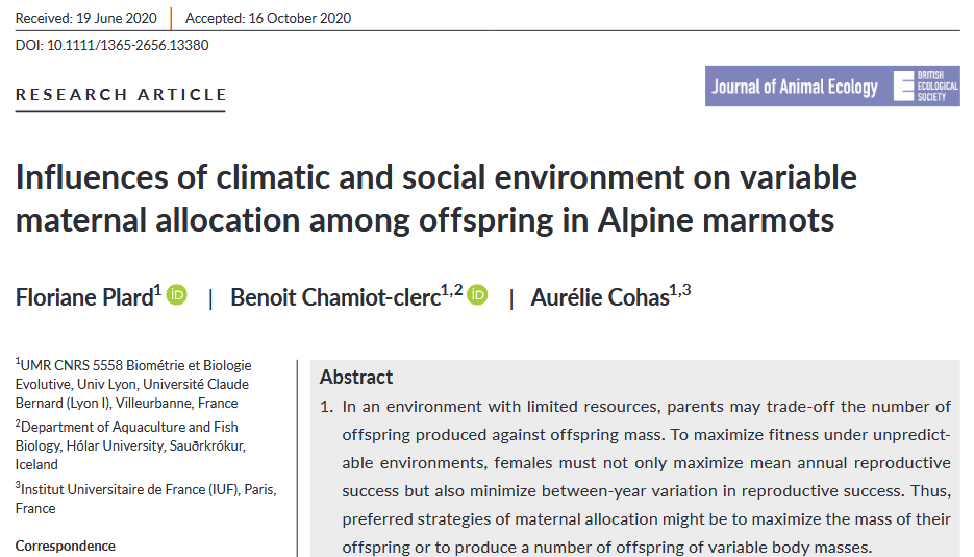
Individual performance in survival and reproduction depends on the interaction between many factors that can be divided between birth individual attributes (genetics, sex, birth environment …) and annual environmental conditions (habitat, resources …). However, it is impossible to use all of these factors in models of population dynamics. I therefore seek to find a minimum number of variables characterizing individual heterogeneity in order to use them in models of population dynamics to model the dynamics of individual heterogeneity.
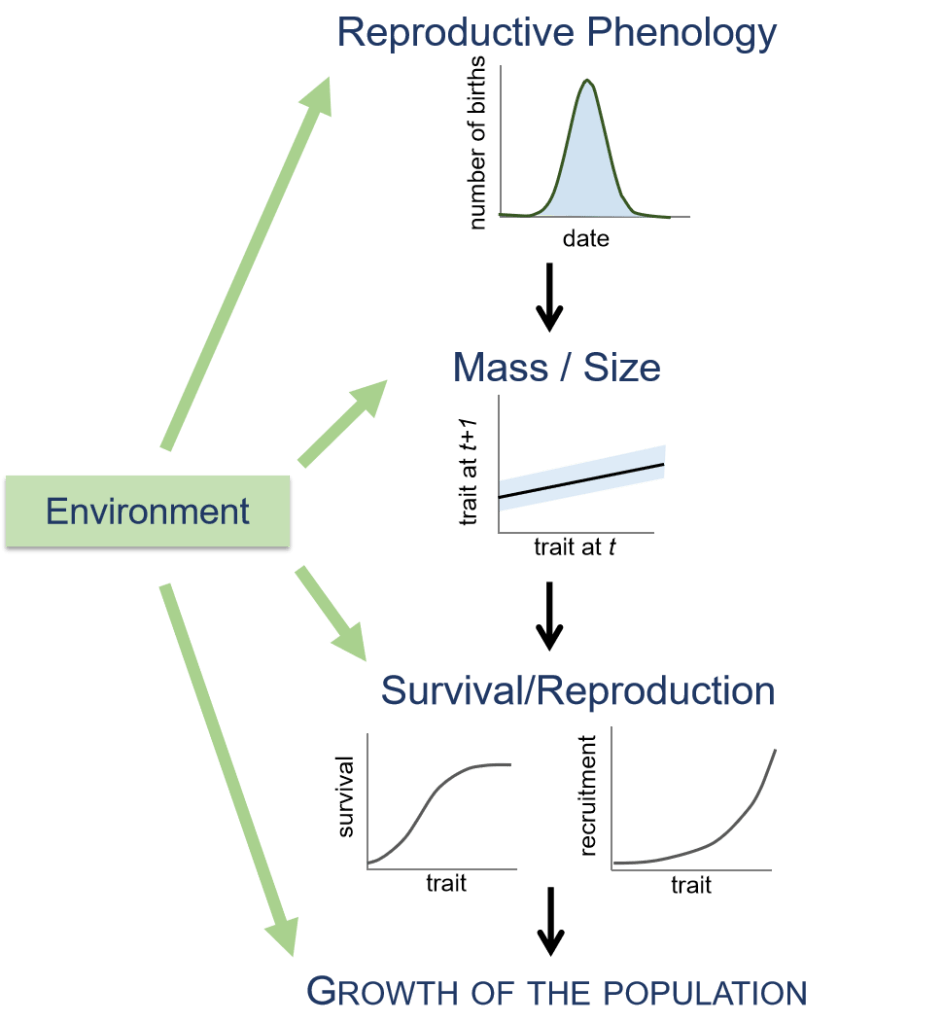
The relationships between annual individual performance, and birth attributes and environmental conditions can be made through dynamic individual traits. I therefore use dynamic phenotypic traits such as body mass or reproductive phenology, which reflect individual annual condition, to be able to model individual heterogeneity in performance. These dynamic phenotypic traits allow me to develop models of population dynamics which, by modeling the dynamics of individual heterogeneity, permit me to predict the responses of populations to environmental changes.
Teaching

University
I taught during my PhD and then as an assistant professor in statistics at the University of Lyon, totaling more than 400 hours of teaching. I mainly teach at Bachelor and Master levels statistics and mathematics applied to biology, as well as R software.

Workshops
I organize and take part in workshops to explain how to build and use models of population dynamics (Integrated population models and Integral projection models, mainly). I use concrete examples and favor direct practice on participant data. These discussions are opportune times for me to insist on how to define and check the assumptions of a model and how to interpret the results obtained. I also support participants to improve their own ability to detect and resolve quickly coding and modeling errors.

Online
Under the lead of the Research Group in Statistical Ecology, I am contributing in the creation of an open teaching platform about statistical models used in ecology. This platform will give the opportunity for many researchers and professors to share their courses with students and colleagues from all walks of life in order to increase the visibility and accessibility of numerous resources. It will allow us to compare our teaching methods and to develop our resources over time. Live teaching or discussion sessions will be organized regularly in order to discuss various problematics and problems encountered.
 Floriane Plard